Emergency obstetric care access in Bungoma County, Kenya
Where women can reach a hospital able to do an emergency C-section, and which upgrades or new sites close the gap. About 100,000 women aged 15 to 49 (11.6%) live more than an hour away on a road-aware travel model, and 84% live nearest a delivery point that cannot operate.
This is a separate study from the earlier emergency cardiac care study in the same county.
Question
How long does it take women aged 15 to 49 in Bungoma County to reach a hospital that can perform an emergency C-section, and which facility upgrades or new sites would bring the most women within reach?
Data
- WorldPop 2026, 100 m, including rasters of women aged 15 to 49
- Facility list with maternity beds and theatres
- SRTM terrain
- ESA WorldCover 2021
- OpenStreetMap roads
- OpenRouteService isochrones
Method
- A friction surface from terrain and land cover.
- Road-aware least-cost travel time across that surface.
- A two-stage referral path: first to a delivery point, then on to a theatre-capable hospital.
- An enhanced two-step floating catchment area (2SFCA) score using real maternity beds and theatres.
- Monte Carlo simulation over travel speed, road winding, birth rate and complication rate (500 runs).
- Upgrade ranking, and a budget knapsack to choose a mix of upgrades.
- A dual maximal covering location problem (MCLP) over new sites and upgrades.
Findings
- Women aged 15 to 49 more than 60 minutes from a hospital that can do a C-section: 11.6% on the road-aware model, using assumed road speeds; the true share could be higher.
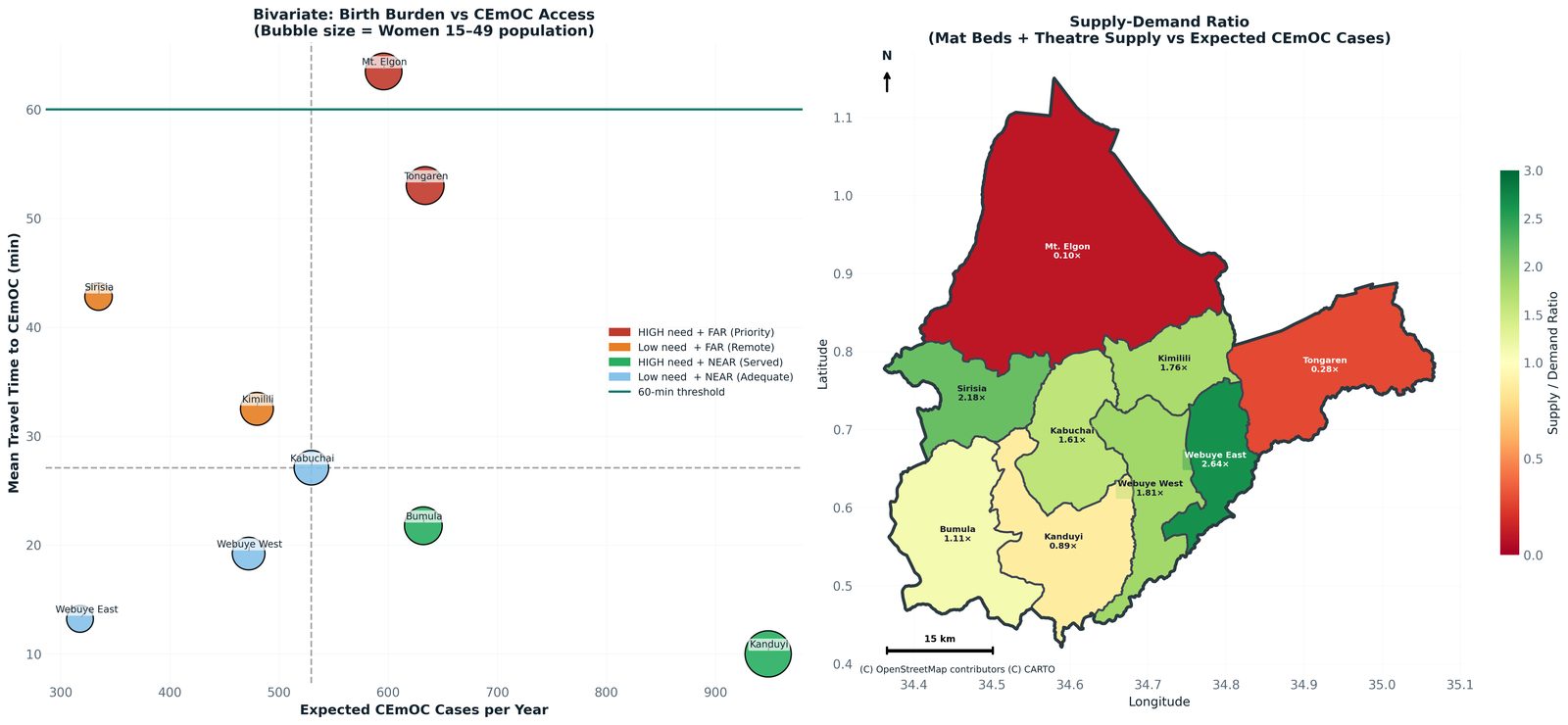
- In Mt Elgon, about half of women live more than 60 minutes away.
- 84% live nearest a delivery point that cannot do a C-section.
- The mean referral path, to a delivery point and then on to a theatre-capable hospital, is about 40 minutes.
- 72% of modelled access depends on private facilities.
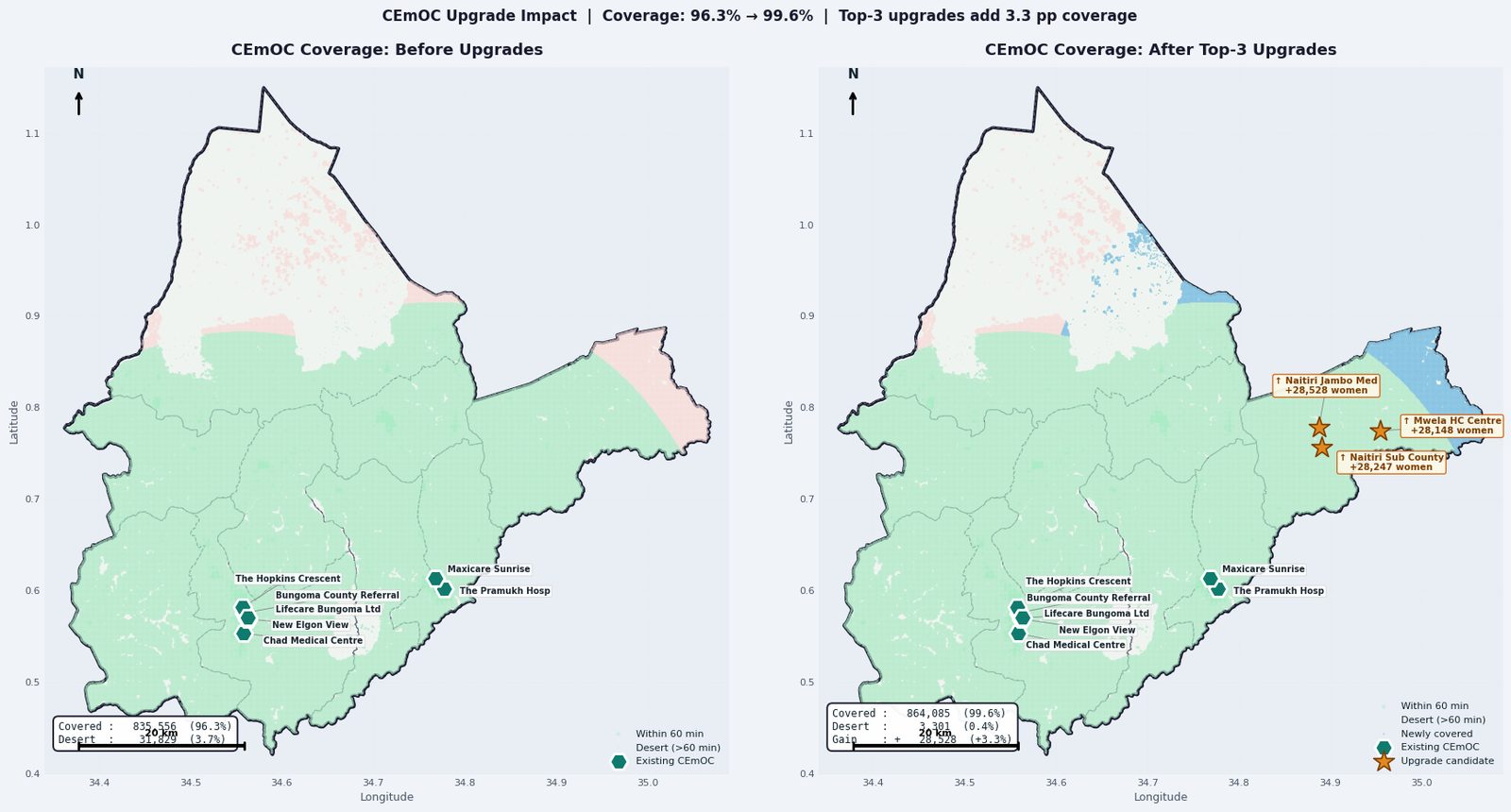
- 3 new sites plus 3 upgrades bring the remaining 31,000 women within the service radius.
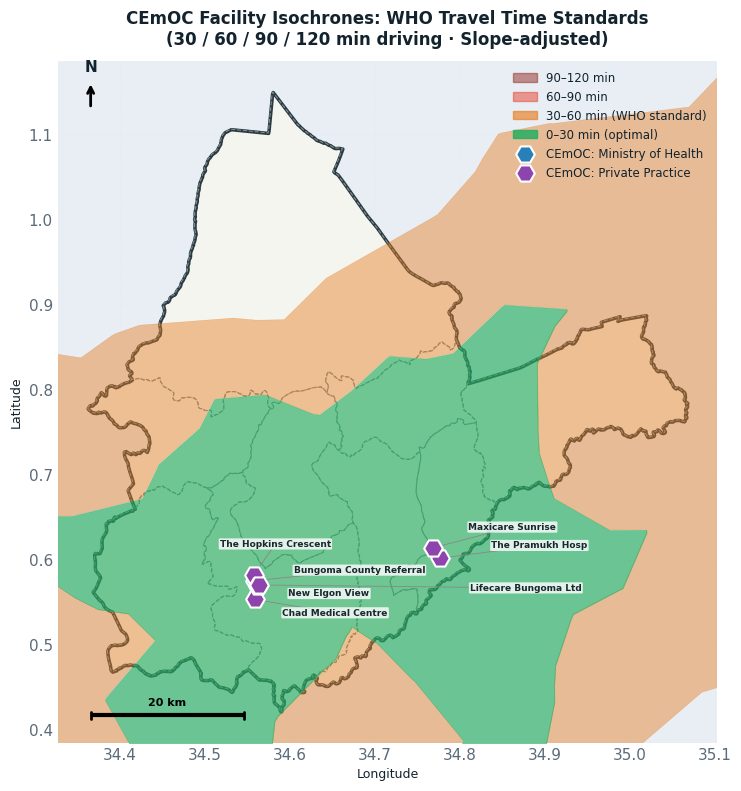
Drive-time zones
Drive-time zones around the seven facilities in the county that can perform an emergency C-section.
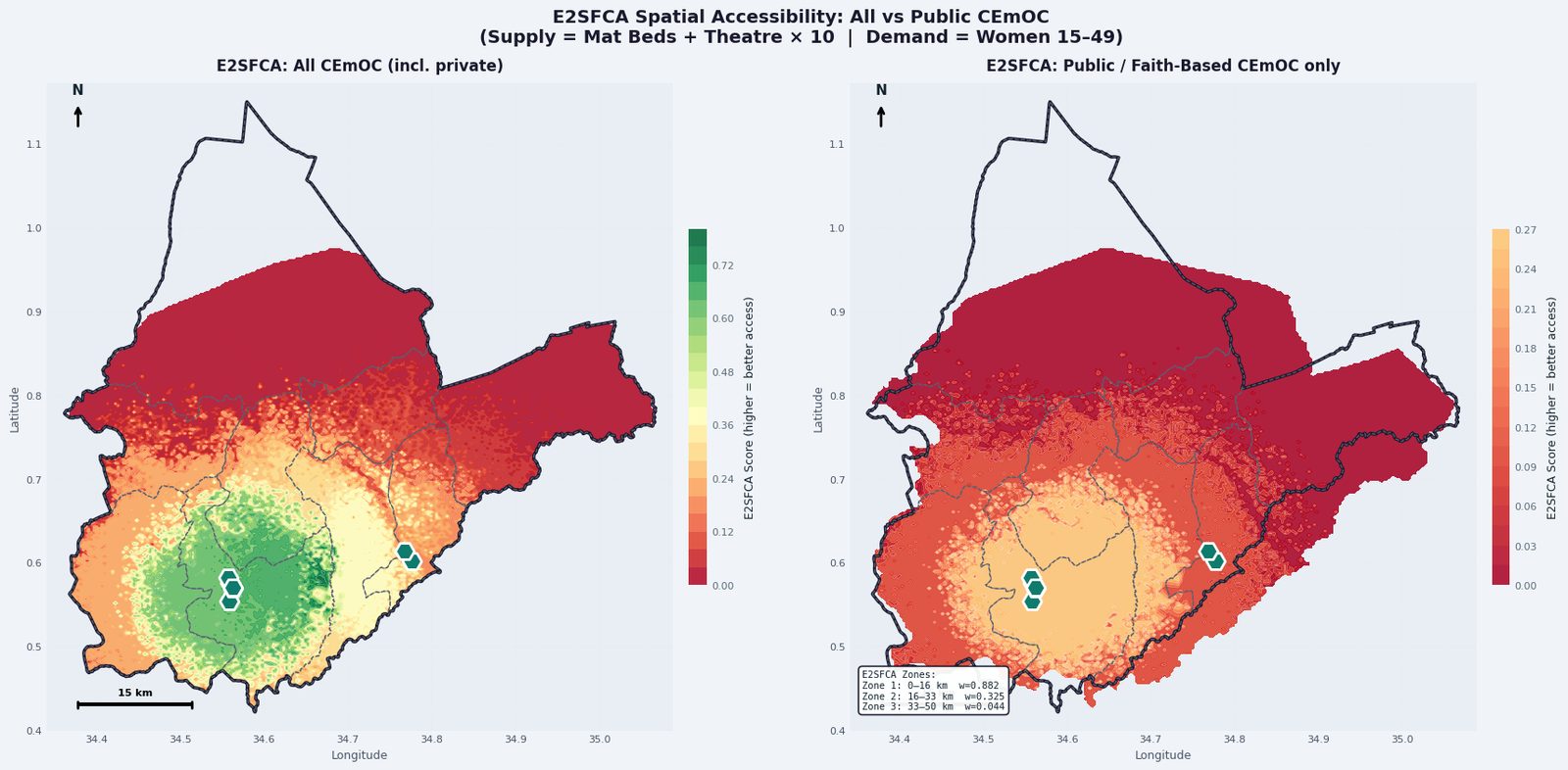
Access with and without private hospitals
An enhanced two-step floating catchment area (2SFCA) score weighs each hospital's maternity beds and theatres against the women who can reach it, so a higher score means more capacity per woman nearby. The left map counts all seven facilities that can do a C-section; the right counts only public and faith-based ones. Without the private hospitals, the share of women with no access rises from 12% to 27%, and 72% of modelled access depends on private facilities.
Need against access
Expected emergency obstetric cases against travel time for each sub-county, and the ratio of beds and theatres to expected cases.
Upgrade impact
Coverage before and after the three top-ranked upgrades.
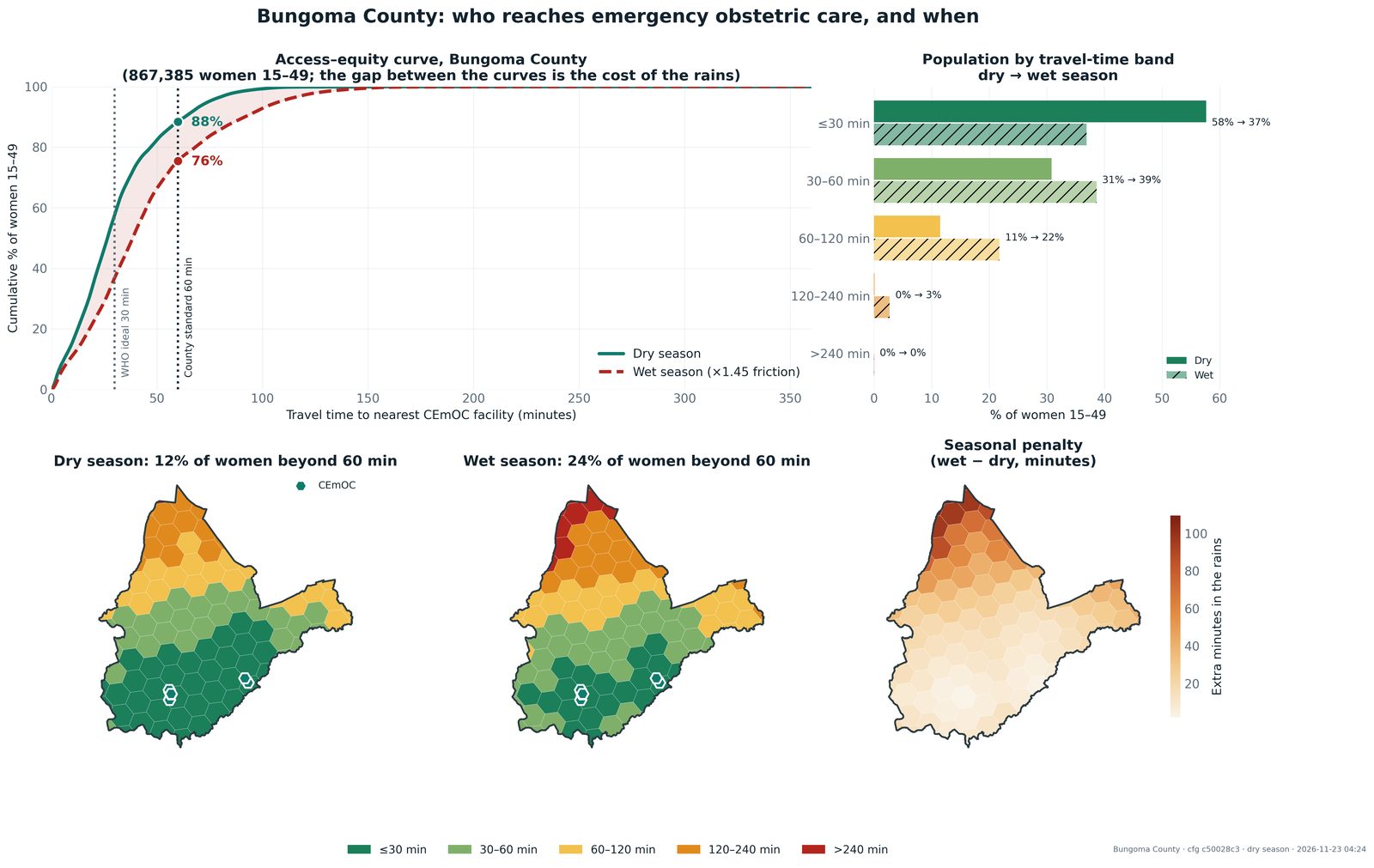
Dry and wet seasons
The share of women within each travel time, and how much the rains lengthen journeys.
Limits
- Upgrade costs are assumed: KSh 50M per Level 3 and KSh 100M per Level 4 facility.
- Several facility records show zero maternity beds and need checking.
- Travel speeds are assumed, not measured.
- The uncertainty is wide. A day of GPS-tracked ambulance trips would narrow it most.
- The uncertainty runs were done on an earlier straight-line model and will be redone on the road-aware model.